
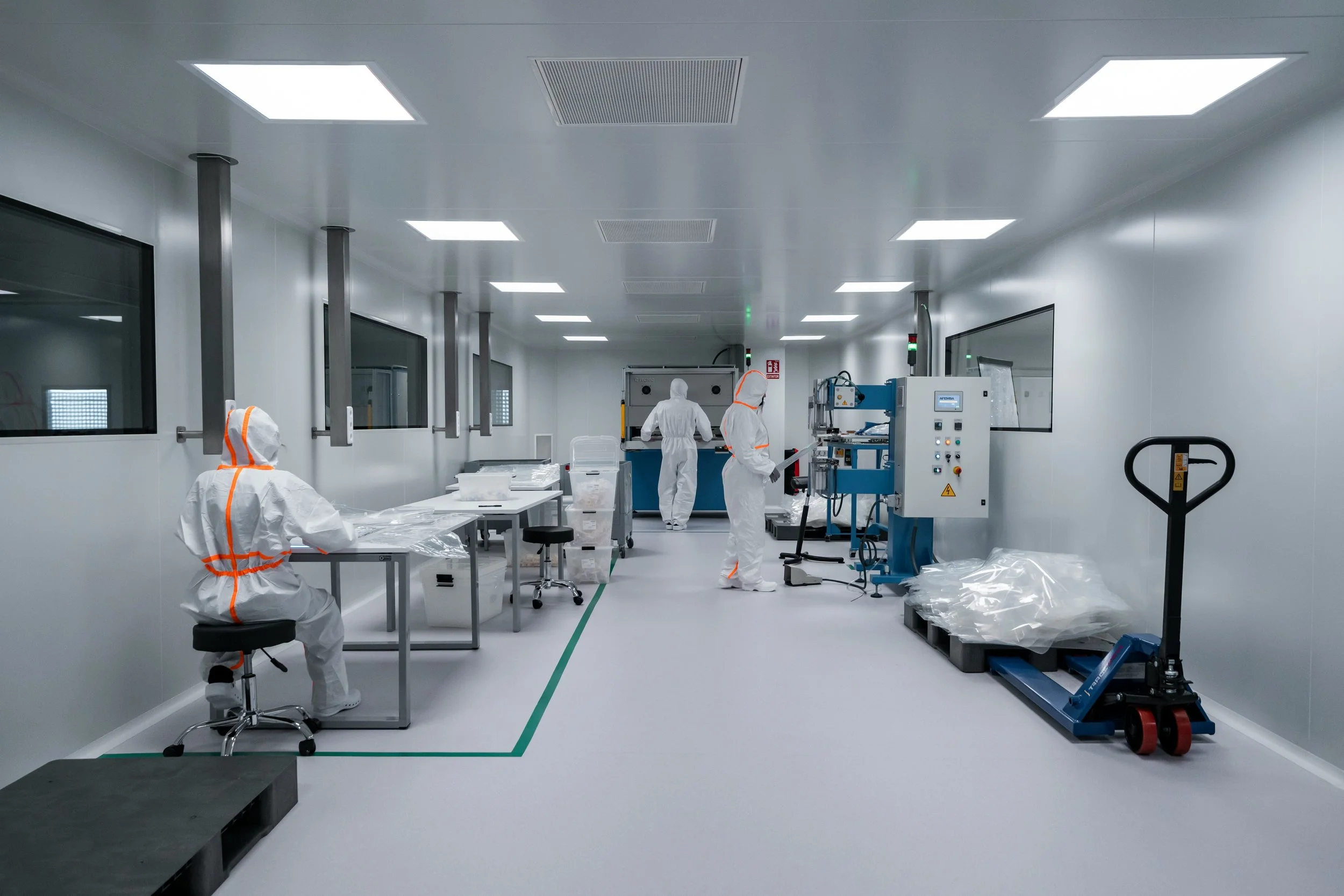
When designing and building a cleanroom environment, the goal sounds simple enough. You want to achieve strict control of airborne particles and microbial contamination. When your standards must be unwavering, every design element is of utmost performance, including the cleanroom flooring materials you choose.
Every time someone enters the cleanroom, they are moving across the floor. While HVAC systems and filters receive most of the attention, flooring can be overlooked.
The wrong flooring choice can compromise compliance and increase your maintenance costs. Worst of all, inappropriate materials will introduce contamination risks that are difficult to control.
Cleanroom flooring also impacts the safety of your work environment. You need a durable space that can hold up over time while also being easy to clean.
Your cleanroom flooring plays a role in contamination control by preventing particle shedding and trapping. It also affects safety by providing a slip-resistant surface for your team members. Finally, its durability must hold up against heavy equipment and harsh chemicals.
If you work in a tightly regulated sector like pharmaceuticals, biotechnology, and semiconductor manufacturing, flooring represents part of your compliance plan. Use it to your advantage. You should understand common cleanroom flooring types, including cleanroom raised access floor systems so that you can identify the ideal solutions for your environment.
What Makes Flooring “Cleanroom-Ready”?
Cleanroom-ready flooring must meet strict requirements. You can’t abide by a traditional commercial flooring checklist. The walking surface in a cleanroom environment should be much more rugged, safer, and easier to sanitize.
One of the most challenging parts involves finding materials that will minimize particulate generation and cross-contamination. You’ll also need to aggressively clean the surface without rapid degradation. A seamless surface will eliminate joints that could allow contaminants to build up. A few performance traits to prioritize first include:
Low Particle Shedding: Materials should not break down or release fibers, dust, or debris
Chemical Resistance: Floors must withstand harsh disinfectants, solvents, and sterilization agents
Ease of Cleaning: A smooth, non-porous surface will harbor fewer microbials
The material you choose directly impacts your contamination control strategy. For example, a seamless resin floor reduces the potential for microbial growth. On the other hand, a vinyl system that was not installed properly will have gaps that can trap contaminants.
Materials to Know
While there are many different commercial flooring products on the market, only a handful of materials are suitable for cleanroom flooring material.
Epoxy & Seamless Resinous Flooring
Epoxy and resin-based flooring systems are poured. These coatings are self-leveling, provided that the installers follow the appropriate steps. The material will cure into a continuous, seamless surface without joints or seams.
These systems are popular in cleanrooms because they result in a smooth, non-porous barrier. Epoxy and resin flooring minimizes particulate buildup and microbial growth. If you are building a permanent cleanroom for pharmaceutical or biotech usage, consider these materials.
Pros include:
Seamless surface that improves contamination control
High chemical resistance
Easy to clean
Cons are:
Can crack under extreme loads
Requires expert installation
Repairs can be complex
The benefits of epoxy or resin flooring far outweigh potential drawbacks.
Vinyl & Static-Dissipative Flooring
Static-dissipative flooring sheets or tiles are engineered with conductive or dissipative additives to manage electrostatic discharge. You should consider these flooring options if you will be working with electronics or sensitive instruments. Any material that is sensitive to static can be compromised without dissipative flooring.
Pros include:
Effective ESD control
Cost-effective compared to resin systems
Available in sheets for fewer seams
Cons include:
Seams can collect particles if not heat-welded properly
Less durable than resin or raised systems
Consult with a cleanroom expert to determine whether a dissipative material is the right fit for your use case.
Raised Access Flooring Systems
Raised cleanroom floor tiles are modular panels installed above a sub-floor plenum, which is an enclosed, pressurized space used to distribute air. The space between the sub-floor and raised tiles creates space for airflow, cabling, and utilities.
Raised access flooring systems are some of the most complex and costly to install. However, raised flooring also provides exceptional flexibility and access to important infrastructure. Semiconductor manufacturers frequently use this style of setup.
Pros are:
Excellent access to underfloor services
Highly modular and customizable
Supports airflow and pressure control
Cons include:
Higher upfront costs
Requires precise installation
Panel joints must be carefully maintained
If your industry demands the level of control and flexibility offered by raised panel flooring, it is a worthwhile investment.
Rubber & Urethane Flooring
Rubber and urethane systems offer great resilience and shock absorption. If your staff members will be spending hours in the cleanroom environment and you want to optimize the flooring for comfort, these are great choices.
Rubber and urethane are typically installed in areas with standing workstations. However, you may be able to install them throughout the workspace if you are constructing a light industrial cleanroom zone.
The flexibility of these materials makes them comfortable for long shifts. However, rubber and urethane are more prone to breaking down in areas with high chemical exposure.
Pros are:
Comfortable underfoot for long-duration work
Excellent slip resistance
Good impact absorption
Cons include:
Lower chemical resistance
Can absorb stains
Rubber and urethane are a good fit if you are working in less stringent cleanroom spaces. These materials are also more cost-effective.
Antistatic & Conductive Floor Materials
Antistatic and conductive flooring systems dissipate electrostatic discharge. These materials can be integrated into epoxy, vinyl, or modular tile. Pros are:
Strong and reliable ESD protection
Can be integrated into multiple flooring systems
Essential for electronics and semiconductor environments
Cons include:
Requires proper grounding
Performance depends on ongoing maintenance
Antistatic and conductive floor materials need to be installed with the support of experts. Otherwise, there is a high likelihood of error.
Explore Cleanroom Flooring Types With CleanAir Solutions
CleanAir Solutions serves clients in a wide array of niches with lots of cleanroom flooring types. Whether you need to build pharmacy cleanrooms or an environment to build sensitive electronics, our experts have the knowledge to support your mission.
Contact CleanAir Solutions for flooring selection, installation, and maintenance guidance.